
Bidirectional Charging (V2H) 2026: Is the Breakthrough Finally Coming?
Protection Against Storms and Severe Weather: What Your Solar Insurance Must Cover
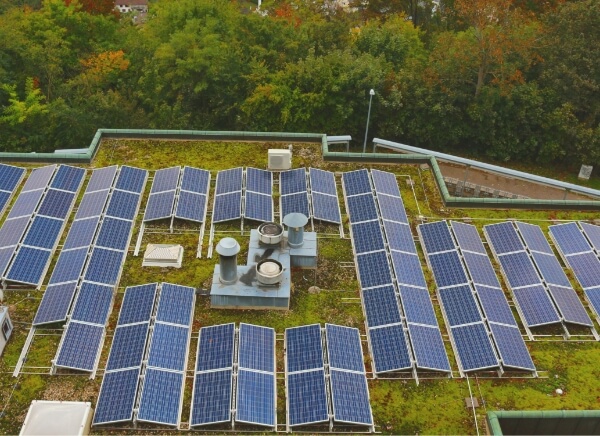
For flat roof solar installations, there is significantly more flexibility in terms of orientation. An east-west system optimally utilizes sunlight in the morning and evening and maximizes roof space usage, while a south-facing orientation delivers particularly high yields under strong sunlight.
Regarding installation, there are two main options:
- Direct mounting on the roof (penetrating the roof membrane).
- Ballasted installation, for example using gravel trays. The ballasted option protects the roof membrane, as no drilling is required. The best solution depends on the roof’s structural stability and the specific requirements of the project.
“We specialize in flat roof installations. Contact us.”
Orientation Considerations – Why a Closer Look Pays Off
- South-facing orientation remains the gold standard for maximum energy yield. Especially in winter, when the sun is relatively low, modules with an optimal tilt of 15–35 degrees deliver the highest output. This is particularly interesting for businesses aiming for maximum self-generated electricity and looking to offset seasonal fluctuations.
- East-west orientation demonstrates its strengths, especially on flat roofs. Modules are installed in a zigzag formation, which provides:
- A more even electricity production throughout the day.
- Better management of peak loads and optimized self-consumption.
- Ideal for businesses with electricity demand concentrated in the morning and evening hours.
While midday yields are slightly lower than with south-facing modules, the production curve remains more stable over the day.
- Additional advantage of flat roofs: enormous flexibility. Since there is no fixed roof slope, modules can be positioned exactly according to your requirements. This allows for precise planning—whether for maximum yield, optimized self-consumption, or targeted avoidance of shading. Such freedom provides extra flexibility in project design and can have a positive long-term impact on the economic efficiency of the system.
Flat Roof Mounting Systems
In raised photovoltaic installations, solar modules are mounted on special frames to ensure optimal orientation and tilt, maximizing system output.
There are two common mounting methods:
- Fixed frames screwed to the roof, requiring roof penetrations.
- Ballasted systems, e.g., using gravel, providing stability even under strong winds.
For special requirements, such as historical buildings or areas with extreme wind loads, low-profile systems with a tilt of 10–15 degrees are ideal. They remain discreet, secure, and efficient while protecting the roof.
Key Planning Considerations
- Roof load capacity: Before installation, a professional must assess whether the roof can reliably support the additional weight of the solar system. Safety comes first.
- Wind and storm resistance: The system must be mounted securely to withstand strong winds or storms. Stability and professional fastening are crucial.
- Module spacing: Ensure sufficient distance between modules to prevent self-shading. Only then will the solar system achieve its maximum potential output.
This article is intended for informational purposes only and does not constitute a binding offer or professional advice.